What counts as a hidden leak
If you can see it, it is not really a detection job — it is a repair. A dripping tap or a visible split under the sink gets fixed on the spot.
Detection is for everything else:
Under the slab
Pipework cast into or run beneath a concrete floor. The signs are indirect — a warm patch of tiles, a hissing when the house is quiet, skirting that will not dry out.
Under paving, driveways and alfresco areas
Common on newer Harrisdale blocks, where the finished landscaping went in over the plumbing.
In a wall cavity
A stain that returns after painting, a mouldy patch in one corner, or a bubbling section of plasterboard.
In the retic
An irrigation line that has cracked will pour water into sand with no surface sign at all. It is the single most common cause of a mystery bill on an estate with established gardens.
On the service line
The run from the water meter at your front boundary to the house. It is buried, it is long on a lot of these lots, and it is under pressure day and night.
Under the hot water unit or behind a fixture
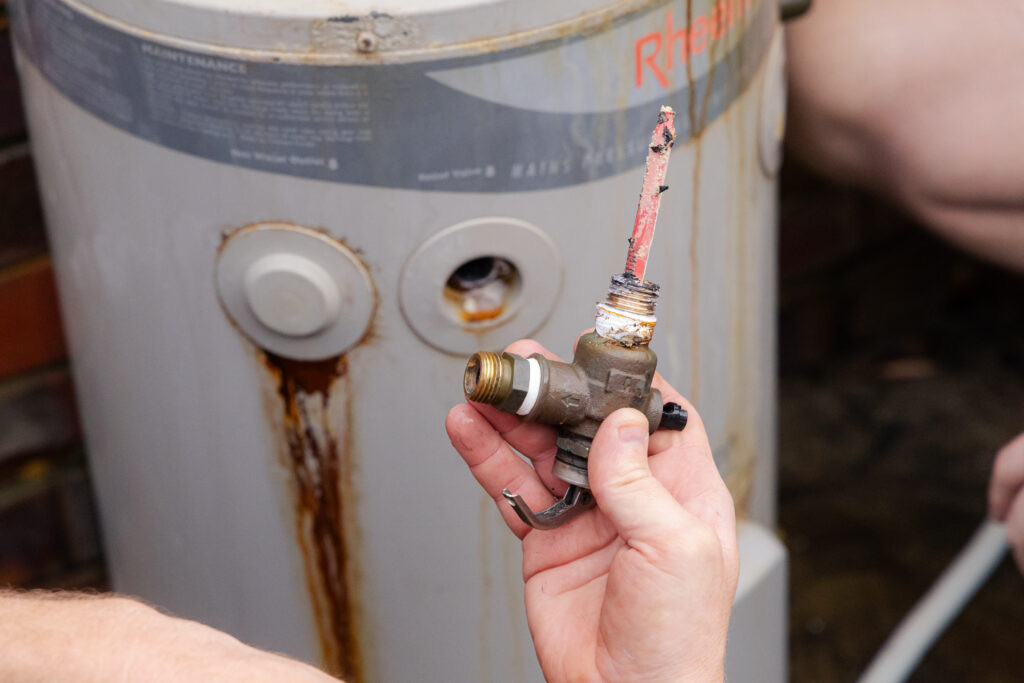
Sometimes what looks like a leak in the plumbing is the appliance. Worth knowing which before anyone opens a wall. Leaking hot water systems
How we find it
The method is elimination. Every step rules something out, so by the end there is only one place left the water can be.
1. The meter
With everything in the house shut off, the meter should be perfectly still. If it is moving, water is escaping somewhere, and the speed gives us the rough size of the loss before we have looked at anything else. If it is still, the loss is intermittent and we chase it a different way.
2. Isolation
We shut off sections of the property one at a time — the house, the retic, the outdoor taps, individual wet areas — and watch what the meter does. This is what separates a leak inside the building from one out in the yard, and it usually takes the search area from a whole property down to a strip.
3. Acoustic location
Water forcing its way out of a pressurised pipe makes a distinct noise. It carries along the pipe and through the ground. Listening gear picks that up at the surface where you would hear nothing standing right on top of it. On a slab leak this is what turns "somewhere in this room" into a mark on the floor.
4. Pressure testing
Isolating a section and putting it under test pressure proves whether that section holds. It is how we confirm we have found the leak rather than a leak, and how we prove the repair worked afterwards.
5. One opening, in the right place
Then the ground or the floor gets opened at the marked spot, the failed section is repaired, and the section is retested. The whole point of the four steps above is that this step is small.
What we find in Harrisdale specifically
Harrisdale was gazetted in 2007 and the main estate did not break ground until July 2010, so nearly every home here is on its original pipework. Nothing has been replaced, which means we are not looking for the corrosion you chase in a suburb built decades earlier.
What we are looking for instead is original workmanship reaching its limit — a joint that was slightly under-done, a pipe nicked by another trade during the build, a fitting that has been under mains pressure for a decade and has finally given up. Those faults hold for years and then appear all at once, which is why they feel so sudden.
The other Harrisdale pattern is water use. With an average household of 3.2 people, normal consumption here is already high, so a leak buries itself in the numbers for a while and then announces itself on one quarter's bill. When the bill is the first sign
After we find it
Finding it is not the end of the job. You get a written price for the repair before anything is opened up, and you decide from there. There is no call-out fee for any of the above, the quote is free, and the pricing is the same whether the answer turns out to be simple or awkward — no hidden costs added on at the end.
If the leak turns out to be somebody else's problem — the main in the street rather than your service line — we will tell you that too, and you will not have paid us to find out.
Related work
A leak is rarely the only thing going on, and these sit next to it.
Burst pipes and water that cannot wait
When it is already running rather than hiding. Emergency plumbing
Drains rather than supply
Water leaving the house through a damaged drain shows up as damp ground rather than a spinning meter. Blocked drains
Water that is not a leak at all
A full or failed soakwell puts water where it does not belong, and it gets mistaken for a leak more often than anything else on this list. Storm water and soakwells
The cheapest one to rule out first
A toilet cistern leaking into the bowl runs continuously and shows nothing on the floor. It is the least expensive cause of a high bill to put right, so it is worth eliminating before anyone starts digging. Leaking toilet repair
Gas rather than water
A separate job, a separate licence, and a different urgency. Gas leak repair
Commercial premises
Same detection work, different consequences. Commercial plumbing
Who does the work
Tim. Plumbing licence 8396 and gas licence 13098, both held by the person who turns up. HouseWorks Plumbing & Gas works out of Leeming, roughly fifteen minutes from Harrisdale, Monday to Friday, 7:00am to 4:00pm.